
TradeDeskDaily Update
This post breaks down the AI capex supercycle that is reshaping markets right now: Big Tech’s $88B debt war chest, the biotech washout, the squeeze in AI infrastructure names, and what today’s flows are really signaling under the surface.
On the surface it looked like chaos: Big Tech tapping the bond market for almost $90B, Amazon dropping a $50B bombshell on federal AI infrastructure, Google ripping double digits, Broadcom going parabolic, Novo Nordisk getting torched, China tech squeezing, and credit card delinquencies quietly grinding higher in the background. Underneath the noise, there’s a simple theme: we’re in an AI capex supercycle funded by the debt markets, and something has to be sold to pay for it.
Think of this post as the “Wall Street edit” of today’s flows: what really moved, why it moved, and how the pieces fit together.
1. Big Tech’s $88B Debt Binge: Fuel for the AI Capex Supercycle
Headlines framed it as “Big Tech floods the bond market with nearly $90B in new debt.” That sounds scary until you look at what the money is actually buying. Alphabet, Meta, Amazon, and Oracle have all tapped credit markets in recent weeks, with combined issuance approaching $90B, and strategists expect net tech debt issuance to hit roughly $100B next year as AI capex ramps.
This isn’t a distressed balance-sheet patch job. It’s a deliberate decision to finance:
- AI data centers (power + land + cooling)
- Custom silicon (TPUs, Trainium-style chips, assorted ASICs)
- Network and storage upgrades to handle model scale
Forecasts now put AI-related capex at more than $400B in 2025 and potentially $600B by 2027, after analysts repeatedly underestimated how aggressively hyperscalers would spend. The debt being raised now is the ammunition for that arms race.
So when you see “$88B in leverage,” don’t picture a late-cycle LBO. Picture a multi-trillion-dollar AI infrastructure grid being pre-funded with cheap(ish) long-term capital. Welcome to the AI Capex Supercycle
2. Amazon’s GovCloud Bet and the AI Capex Supercycle
The single most important headline today might end up being an AWS press release that most retail never read.
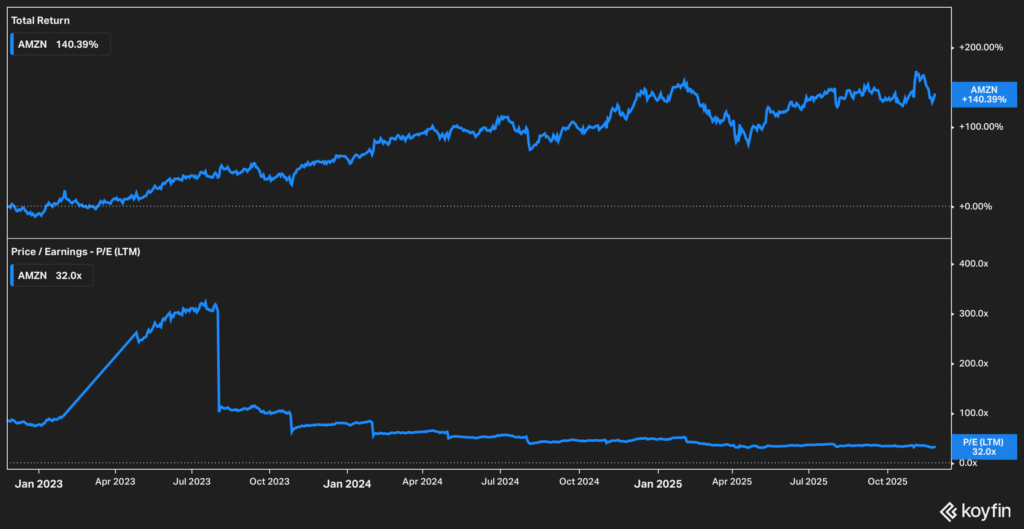
Amazon announced plans to invest up to $50B to build roughly 1.3 gigawatts of AI and high-performance compute capacity dedicated to U.S. government customers across its AWS Top Secret, Secret, and GovCloud regions. That’s not marketing fluff. It’s concrete, power, land, and racks locked in against long-duration federal workloads in cybersecurity, energy, healthcare, and national security.
Layer that on top of Amazon’s existing capex trajectory and the picture gets wild. In Q3 2025, Amazon’s capex jumped 55% YoY to $35.1B, and the company lifted its full-year 2025 guidance to about $125B — more than half of projected operating cash flow and roughly 17% of revenue.
From a TradeDeskDaily perspective, this is huge:
- It effectively underwrites a chunk of AWS capex with federal contracts.
- It creates a floor for AI infrastructure utilization across GovCloud.
- It pushes Amazon deeper into “systemically important infrastructure” territory, not just e-commerce + ads.
That’s why you’re seeing accumulation in the $200s: the market is treating this as a multi-year, government-backed revenue stream, not a one-off AI press release.
3. Google’s Gemini 3 Moment: Meme Trade or Institutional Re-Rating?
Retail saw the WallStreetBets screenshots. TradeDeskDaily saw something different.
Alphabet stock has been on a tear in 2025, with shares up more than 50% year-to-date and repeatedly printing new all-time highs. The latest leg came as Google formally rolled out Gemini 3, its next-gen model, with strong early reviews and a visible push to position TPU hardware as a credible alternative to Nvidia’s GPU stack.
On launch, the stock rallied as much as 6–7% intraday, its biggest move in months, and call option volume spiked above typical full-day averages before lunch.
- Traders were selling downside puts to finance upside calls.
- Skew flattened as traders reached for exposure rather than hedges.
- Analysts framed the move as a “re-rating of Google’s AI infrastructure story,” not just chatbots and search.
Add in reports that Google is pushing TPUs harder into third-party data centers and structuring large-scale AI deals with partners like Anthropic, and it’s clear: this is an institutional rotation into Google as an AI platform, not just a meme pump.
4. Broadcom: The Hidden Winner Riding Google’s Wake
If Google is the front-end story, Broadcom is the back-end story.
Broadcom jumped double-digits as the market finally internalized just how closely tied its fortunes are to hyperscaler AI infrastructure. The company has been Google’s primary partner on custom AI ASICs for TPUs, and analysts now estimate that well over half of Broadcom’s AI compute revenue is anchored to that relationship.
Big picture:
- Broadcom sits at the center of a second, quieter arms race: custom silicon vs. Nvidia’s general-purpose GPUs.
- All five major hyperscalers (Amazon, Microsoft, Google, Meta, Oracle) rely on Broadcom somewhere in their custom chip pipelines.
- As AI capex supercycle estimates have been revised up from $250B to more than $400B for 2025, Broadcom’s opportunity set has ballooned with them.
Today’s $AVGO action was a classic “sympathy squeeze”: Google rips, options go bid, and anything levered to hyperscaler AI infrastructure gets dragged higher. Great to trade — just don’t confuse a one-day melt-up with a risk-free long. Lock in some of that lotto premium.
5. Biotech Takes the Pain: Novo Nordisk’s EVOKE Faceplant
While AI names were levitating, biotech quietly took a beating — led by Novo Nordisk.
Novo reported topline results from its EVOKE and EVOKE+ phase 3 trials testing an oral form of semaglutide in early Alzheimer’s disease. The drug failed to meet the primary endpoint: it did not significantly slow cognitive decline versus placebo, even though some biomarkers moved in the right direction.
The market reaction was brutal. Shares dropped around 10–12% intraday, wiping out a chunk of the “semaglutide cures everything” premium that had been priced in after runaway success in obesity and diabetes.
Key implications:
- The Alzheimer’s TAM is now much more clearly Lilly + Biogen territory, with their amyloid-targeting drugs holding the lead.
- Novo’s GLP-1 franchise is still a monster, but the market will demand proof before paying for non-metabolic indications.
- Biotech as a funding source: in a world where the AI Capex supercycle needs capital, speculative healthcare often becomes the ATM.
For now, $NVO goes back into the “show me” bucket until the next pipeline readout. Capital is rotating into names like Eli Lilly and select med-tech instead.
6. Under the Hood: Consumers Are Quietly Stressing Out
Zooming out from single names, today’s flows sit on top of a more uncomfortable macro story: corporate balance sheets are expanding while household balance sheets are fraying.
The New York Fed’s latest Household Debt and Credit report shows:
- Total household debt at a new record, with balances rising across mortgages, auto loans, and credit cards.
- About 4.5% of total debt now in some stage of delinquency, with transitions into serious delinquency increasing across most categories.
- Credit card balances above $1.23T, and delinquency rates elevated relative to pre-COVID norms.
Put differently: Big Tech is issuing bonds to build data centers, while households are riding higher interest costs on revolving balances. That divergence tends to resolve through volatility, not a gentle glide path.
Practical takeaway: if you’re long AI/high-beta tech, consider pairing with consumer staples, quality credit, or even short exposure to subprime-sensitive consumer names as a hedge. (not financial advice, review our legal policy -> here)
7. China Corner: Alibaba’s Qwen Pop Is Still a “Rent, Don’t Own” Trade
China tech finally caught a bid, with $BABA up on strong early data from its revamped Qwen AI app. The app crossed more than 10 million downloads within a week of relaunch, signalling that Alibaba’s home-grown model is gaining real consumer traction.
That’s good news for sentiment, but flows tell a different story:
- Most of the move looked like short covering + momentum chasing, not fresh institutional capital.
- Foreign investor positioning in China remains light, with little evidence of sustained ETF or direct inflows.
- The trade remains highly correlated to Nasdaq risk sentiment; when U.S. tech cools, China tech tends to fade right alongside it.
Until we see persistent foreign buying and more policy clarity, China tech — including Alibaba — remains a “rent, don’t marry” trade during this AI Capex supercycle.
8. The AI Capex Supercycle: Who’s Funding Whom?
Tie all of this together and the flows picture gets very clear:
- Debt markets are funding the AI Capex Supercycle for Alphabet, Amazon, Meta, Oracle and friends.
- Equity markets are rewarding infrastructure winners like Nvidia and Broadcom with premium multiples and fresh capital.
- Funding sources include biotech, small-cap growth, and increasingly the stretched corners of consumer and China tech.
This is the AI capex supercycle in real time: winners are being over-funded to accelerate, while structurally weaker sectors are sold to pay the bill.
9. How to Trade This Tape (Not Advice, Just a Framework)
Nothing here is financial advice, but if you’re trying to build a coherent playbook out of today’s madness, a few principles stand out:
- Lean into structural AI winners (Amazon, Google, Nvidia, Broadcom) on pullbacks, not breakouts.
- Respect crowding risk: the more obvious the story, the more violent the drawdowns when macro or positioning flips.
- Use pairs and hedges: long AI infrastructure vs. short over-levered consumer or speculative biotech can make the macro divergence work for you.
- In China tech, rent, don’t own until flows and policy both turn sustainably.
Most importantly: separate narrative from flows. The headlines push one story; the tape usually tells another.
(not in any way financial advice, always do your own due diligence. check our policy)
10. Your Turn: What Did You Trade Today?
We’ll keep updating this framework on Trade Desk Daily as new earnings, AI capex numbers, and macro data hit the tape. If you found this breakdown helpful:
- Drop a comment with your best trade of the day: did you ride the $GOOGL wave, catch the $AVGO sympathy squeeze, fade $NVO, or sit in cash?
- Share this post with someone who still thinks the $88B bond headlines were about “reckless leverage.”
- Follow us on X – @TradeDeskDaily !!!
The AI Capex supercycle isn’t over. It just keeps finding new ways to reprice everything else.
Sources
- AI-Spending War and AI-Debt Pile-Up Could Squeeze Share Buybacks – Wolf Street
- Jitters Over AI Spending Set to Grow as US Tech Giants Flood Bond Market – Reuters
- Flood of AI Bonds Adds to Pressure on Markets – The Wall Street Journal
- Mega-Issuance and the AI Arms Race: Big Tech’s Impact on Credit Spreads – Janus Henderson
- Amazon Pledges Up to $50 Billion to Expand AI, Supercomputing for US Government – Reuters
- Amazon to Invest Up to $50B to Build AI Infrastructure for US Government Agencies – Fox Business
- AWS to Build 1.3 Gigawatts of Government-Grade Supercomputing Power – The Register
- Amazon Announces Up to US$50 Billion Investment to Expand AI and Supercomputing for US Government Customers – DigiTimes Asia
- Google’s Gemini 3 Advances Shake Up AI Competitive Landscape – Yahoo Finance
- Gemini 3 Is a Game Changer for the AI Infrastructure Layer – EnerTuition (Substack)
- Novo Nordisk Alzheimer’s Drug Trials Fail in Blow to Weight-Loss Giant – Reuters
- Novo Nordisk’s Oral GLP-1 Drug Didn’t Work on Alzheimer’s as Hoped – MarketWatch
- Weight-Loss Drugs Don’t Appear to Work Against Alzheimer’s – TIME
- Novo Nordisk Announces Topline Results from the EVOKE and EVOKE+ Trials of Semaglutide in Early Alzheimer’s Disease – Alzheimer Europe
- Readout of Phase 3 Semaglutide Trials Marks Critical Moment in Alzheimer’s Research – Alzheimer’s Drug Discovery Foundation
- Household Debt Balances Grow Steadily; Mortgage Originations Ease – Federal Reserve Bank of New York
- Household Debt and Credit Report – Federal Reserve Bank of New York
- A Note on Recent Dynamics of Consumer Delinquency Rates – Board of Governors of the Federal Reserve System
- US Household Debt Up Modestly in Third Quarter, New York Fed Says – Reuters
- Alibaba’s Qwen Chatbot Exceeds 10 Million Downloads Faster Than ChatGPT and DeepSeek – South China Morning Post
- Alibaba’s Main AI App Draws 10 Million Downloads in Strong Debut – Bloomberg
- Alibaba’s Qwen App Surpasses 10 Million Downloads Within First Week – Alizila (Alibaba Group)
Leave a Reply