
Table of Contents
- What Is a Long-Term Portfolio?
- Why a Long-Term Portfolio Matters
- Stocks vs ETFs in a Long-Term Portfolio
- How Much Cash Should You Keep?
- How to Build a Long-Term Portfolio (Step-by-Step)
- Adjusting Your Portfolio Over Time
- Why Most Investors Fail
- How to Start Today
- FAQ (Schema)
What Is a Long-Term Portfolio?
A strong long-term portfolio is the engine behind real wealth creation. While trading gets attention, long-term investing, consistent asset allocation, and disciplined contributions are what drive financial independence. This guide breaks down a simple, proven framework for building a long-term portfolio using stocks, ETFs such as SPY and QQQ, and an appropriate cash position.
By the end, you’ll go from “I know I should be investing…” to “Here’s my actual long-term plan.”
Why a Long-Term Portfolio Matters
Short-term trading is optional — long-term investing is not.
Decades of market data show:
- 📈 ~10% long-term average annual returns (7–8% after inflation)
- 🔁 Consistent upward trajectory despite recessions, bear markets, and crises
- 💰 Massive compounding when dividends are reinvested
Yet most investors underperform because they:
- Hold too much idle cash
- Chase trending stocks
- Panic-sell during downturns
- Don’t have a clear long-term portfolio strategy
A simple, rule-based portfolio removes emotion and replaces it with process.
Stocks vs ETFs: The Core of a Long-Term Portfolio
A long-term portfolio relies primarily on stocks and ETFs, each serving a different role.
1. Individual Stocks — Higher Risk, Higher Reward
Individual stocks offer:
- Higher upside if you pick winners early
- Higher volatility (big swings both directions)
- Concentration risk — one bad pick hurts the portfolio
You should choose individual stocks only when:
- You deeply understand the business
- You can tolerate drawdowns
- You’re truly investing for 10+ years
2. ETFs — Instant Diversification, Lower Stress
Exchange-Traded Funds (ETFs) spread risk across hundreds of companies.
Top ETF types for long-term portfolios include:
- S&P 500 ETFs: SPY, VOO, IVV
- Total Market ETFs: VTI, SCHB
- Dividend ETFs: SCHD, VIG
- International ETFs: VXUS, IXUS
- Tech/Innovation ETFs: QQQ, VGT
ETFs are ideal for:
- Beginners
- Risk-conscious investors
- Anyone seeking consistent long-term performance
Remember:
📌 80–90% of long-term success comes from asset allocation, not stock-picking.
How Much Cash Should You Keep in a Long-Term Portfolio?
Cash is misunderstood. You need some, but too much destroys returns.
✅ You SHOULD hold cash for:
- Emergency fund (3–6 months)
- Near-term expenses (house, car, tuition)
- Buying opportunities during market dips
- Rebalancing your long-term portfolio
❌ You should NOT hold excess cash because:
- Inflation erodes purchasing power
- Cash earns nearly 0% real return
- It slows down compounding
Rule of Thumb:
Keep enough cash to sleep well — invest the rest.
How to Build a Long-Term Portfolio (Step-by-Step)
Here’s a simple, proven model:
⭐ 50% — U.S. Stock Market ETFs
- Examples: VTI, VOO, SCHB
- Reason: Core long-term growth engine
⭐ 20% — International ETFs
- Example: VXUS
- Reason: Broader global diversification
⭐ 20% — Bonds or Cash Equivalents
- Examples: BND, TLT, short-term Treasuries
- Reason: Stability + reduced volatility
⭐ 10% — “Growth Wing” (Optional)
Use this for higher-risk, higher-opportunity assets:
- Tech ETFs
- Individual stocks
- Bitcoin or crypto
- Emerging markets
- Sector rotation themes
This structure is simple, diversified, and builds wealth reliably over decades.
Adjusting Your Long-Term Portfolio Over Time
A long-term portfolio should evolve as your risk tolerance changes.
20s–30s: Maximize Growth
- 80–90% in equities
- Minimal bonds
- Dollar-cost averaging into ETFs
- Focus on long-term growth
40s–50s: Increase Stability
- 60–70% equities
- 30–40% bonds/cash
- More conservative ETFs
60s+: Preserve Capital
- Bond ETFs, dividend ETFs, cash equivalents
- Focus on income + capital protection
General Rule:
More risk early, less risk later.
Why Most Investors Fail (and How You Can Avoid It)
Most losses come from behavior, not investments.
Avoid:
❌ Trying to time the market
❌ Checking your portfolio too often
❌ Over-concentrating in one stock
❌ Panic-selling during downturns
Winning at long-term investing is simple:
📌 Be consistent
📌 Be diversified
📌 Stay fully invested
📌 Let compounding do the heavy lifting
Why You Shouldn’t Time the Market
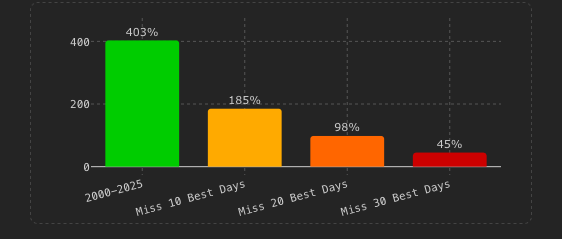
If you try to “wait for the right moment,” you’ll almost certainly miss it.
Missing the 10 best days over a 25-year period cuts your return in half.
Missing the 30 best days? You barely beat inflation.
And the biggest secret:
Most of the best days happen immediately after the worst days.
This means panic-selling guarantees you miss the recovery.
Stay invested. Stay disciplined.
How to Start Building Your Long-Term Portfolio Today
A simple checklist to begin:
- Choose your target allocation
- Pick 2–5 core ETFs
- Decide how much to invest monthly
- Turn on automated investing
- Rebalance once a year
- Ignore short-term market noise
If you follow ONLY these steps, you’ll outperform most traders and stock pickers over 20–30 years.
👉 For deeper strategy guides, explore our latest research here.
FAQ — Long-Term Portfolio Strategy
1. What is a long-term portfolio?
A long-term portfolio is a diversified combination of stocks, ETFs, and cash designed to grow steadily over decades through compounding and disciplined investing.
2. How much should I invest in ETFs vs stocks?
Many investors put 70–90% into ETFs and reserve 10–30% for individual stocks.
3. How often should I rebalance?
Once per year is ideal. Rebalancing more often typically reduces net returns.
4. How much cash should I keep?
Keep 3–6 months of expenses + extra cash only for near-term needs.
5. Are ETFs safer than individual stocks?
Yes. ETFs provide instant diversification, lower risk, and more stable long-term performance.
Learn More Here :
- JP Morgan Asset Management -> Long Term Investing
- Investopedia -> 10 Tips for Successful Long-Term Investing
- U.S. Bank -> Buy and Hold Long Term Investing
Disclaimer
Not investment advice. This article is for educational purposes only.
Review our full legal disclaimer here → Legal
Leave a Reply