
Tomorrow’s September 2025 U.S. employment report finally drops at 8:30 a.m. ET on Thursday, November 20th, six weeks late thanks to the 43-day government shutdown. That delay has turned a normally high-impact data point into the key macro event ahead of the December 9–10 FOMC meeting.
This NFP report preview breaks down what traders need to know ahead of tomorrow’s delayed nonfarm payrolls release. With the labor market cooling and the Fed torn on December rate cuts, this NFP print will shape market sentiment across equities, bonds, and FX.
For Trade Desk Daily readers, the question is simple:
Is this still just a slow-bleed cooldown in the labor market, or the front edge of something uglier – and how should traders position around it?
NFP Report Preview: What Tomorrow’s Jobs Numbers Mean for Markets
Here’s where consensus and the macro backdrop sit going into the print:
- Headline NFP (September, released tomorrow): Street looking for roughly 50–60K jobs added, up from +22K in August but miles below the 12-month pre-summer average of ~147K.
- Unemployment rate: Expected to hold at 4.3%, already a ~4-year high.
- Average hourly earnings: Median call is +0.3% m/m (~3.6–3.7% y/y) – steady wage growth but no sign of a wage-price spiral.
- Inflation backdrop: Latest headline CPI at 3.0% y/y (September), with Cleveland Fed nowcasting something just under 3% for Oct/Nov.
- Fed policy: Fed funds target range 3.75–4.00%, with markets pricing roughly a coin-flip to modest odds-on for a December rate cut -> FRED Target Range
- Risk assets: The S&P 500 is grinding around the 6,600s after a tech-led pullback, with dip-buyers re-emerging but breadth still tired.
- Rates: The 10-year Treasury yield is sitting near 4.1–4.2%, ticking higher this week and flashing some funding stress via elevated repo rate 10 year bond note
Bottom line: late-cycle vibes – growth slowing, inflation back near 3%, the Fed not quite done fighting, and labor data rolling over but not collapsing.
Why This Month’s NFP Report Matters More Than Usual
Normally NFP is just one data point in a steady stream. This one is different for three reasons:
1. It’s delayed – and the October report is cancelled
- The 43-day government shutdown froze BLS data collection for key surveys.
- Result:
- September jobs report (the one we get tomorrow) was pushed to Nov 20.
- The October report is effectively cancelled – BLS couldn’t run the household survey, so no unemployment rate for that month (odd).
- November jobs and CPI will likely show up late and scrambled.
That means tomorrow’s report may be the only clean labor data the Fed has before the December meeting.
2. The labor market is already clearly cooling
- August NFP was just +22K, with downward revisions to prior months – a huge step down from the ~150K pace earlier in the year. Aug Employment Summary
- Jobless claims and continuing claims have trended higher, with continuing claims around 1.95M by mid-October.
- Economists broadly agree: the labor market has shifted from “hot” to “sluggish and fragile” – not yet a full-blown jobs recession, but the risk is rising. ADP Research
3. The Fed is split – and watching this closely
- The Fed has already eased from the 5.25–5.50% peak; fed funds are now 3.75–4.00% after cuts in September and October. Fed Prime Rate
- Fed minutes and commentary show serious division: some officials say inflation is still sticky; others, like Governor Waller, argue the weakening jobs market already justifies another cut in December.
- Futures imply ~50–60% odds of another cut at that meeting – not a done deal
Tomorrow’s print is therefore not just “another NFP”; it’s effectively a live vote on whether the Fed leans dovish or stays cautious into year-end.
NFP Forecast — What Economists Expect for Payrolls, Wages, and Unemployment
Growth
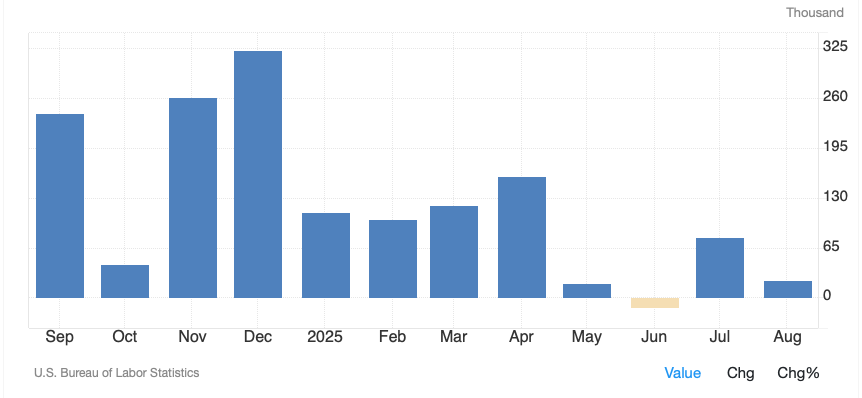
- Payroll growth has downshifted from triple-digit monthly gains to something closer to stall speed (20–60K).
- Business surveys and private payroll trackers show small net job losses in parts of the private sector, with employers slowing hiring but not yet firing aggressively.
Think of this as a “grind-down” labor market:
- Fewer openings, slower hiring, more time on unemployment rolls – but still far from crisis conditions.
Inflation
- Headline CPI is running at ~3.0% y/y, with core measures and Fed nowcasts suggesting inflation is hovering just under 3% and no longer in free-fall.
- Shelter inflation is moderating, goods inflation is mostly tamed, but services and wages keep the floor under 2%. Bureau of Labor Statistics
So inflation is “good enough to cut if growth really rolls over, but not low enough to ignore.” That’s why this jobs report matters so much.
Financial conditions
- Equities: The Nasdaq and S&P 500 have bounced today after a multi-day slide, helped by big tech and Nvidia-related optimism, but breadth is weak and new lows still outnumber new highs for many stocks.
- Rates & funding: The 10-year yield at ~4.1% plus elevated repo rates signal tight year-end funding even after Fed cuts.
- Risk sentiment: Crypto and more speculative assets have sold off sharply on fading rate-cut hopes, a sign that the “easy liquidity” trade is off autopilot.
Net-net, the market is in “nervous, late-cycle risk-on” mode: still buying dips, but increasingly sensitive to bad macro surprises.
Key Numbers Traders Should Watch in the NFP Report
For traders on Trade Desk Daily, here’s the practical checklist for tomorrow’s print:
- Headline Nonfarm Payrolls (NFP)
- Consensus: ~50–60K.
- Lens:
- Below 0K: recession alarm bells – markets will question whether the Fed is behind the curve.
- 0–25K: confirms a very weak labor market; bullish for bonds, likely negative for cyclicals and credit.
- 25–75K (consensus-ish): keeps the “slowdown, not collapse” narrative alive.
- >100K: suggests more resilience; risk that the market starts pricing fewer cuts.
- Unemployment Rate (U-3)
- Consensus: 4.3%, matching August.
- Watch:
- A move to 4.4%+ would reinforce the “weak labor” camp at the Fed.
- A drop back toward 4.1–4.2% would be a genuine surprise and could stiffen the Fed’s spine against December easing.
- Average Hourly Earnings
- Consensus: +0.3% m/m (~3.7% y/y).
- Key:
- 0.1–0.2% m/m: the Fed gets comfort that wage pressure is fading.
- 0.4%+ m/m: raises questions about sticky services inflation and could offset a weak headline NFP.
- Revisions
- August and June/July have already seen downward revisions. If BLS cuts prior months again, the trend looks worse than markets currently price.
Market Scenarios Based on Tomorrow’s NFP Report
(Nothing here is advice, just a trading framework. Disclaimer -> Here)
Scenario 1: “Goldilocks Weak” – Near Consensus, Slightly Soft
- Data: NFP 30–60K, unemployment at 4.3%, wages +0.3% or slightly lower, minor negative revisions.
- Narrative: Labor market is cooling, not collapsing; Fed gets cover for a single quarter-point cut in December, not a full easing cycle.
- Likely reactions:
- Equities: Relief bid. Growth and quality tech outperform; cyclicals lag but don’t collapse.
- Rates: 10Y yields drift lower (bullish Treasuries), curve flattens modestly as front-end rallies on cut expectations.
- Dollar: Mixed to slightly weaker vs. high-beta FX as “soft landing” odds rise.
Trading angle:
- For futures traders, this favors long ES/NQ on dips with tight risk, and long TY/ZN against a defined stop if yields spike intraday first.
- Options traders might look at selling post-event vol if the reaction is controlled and the data sits in this middle band.
Scenario 2: “Bad Weak” – Clear Deterioration
- Data: NFP <25K or negative, unemployment 4.4%+, prior months revised down, wages sub-0.2%.
- Narrative: Labor market has moved from “cooling” to soft or outright recessionary, especially given the shutdown hit.
- Likely reactions:
- Equities:
- First move could be risk-off in cyclicals, small caps, and credit-sensitive names.
- Mega-cap “quality” may initially outperform but will struggle if recession odds spike.
- Rates:
- Front-end rips higher (2Y yields down hard) as markets price multiple cuts.
- Curve steepens (bull steepener) as growth fears pull long yields lower.
- Dollar:
- Could sell off vs. safe havens (JPY, CHF) but might hold up vs. high-beta EM depending on risk sentiment.
- Equities:
Trading angle:
- Bond futures (ZN, ZB) and rate-cut trades (SOFR/FF futures) likely see the cleanest trend.
- In equities, put spreads on cyclical sectors or long volatility structures can benefit if the market shifts from “dip-buying” to “de-risking.”
Scenario 3: “Too Hot” – Upside Surprise
- Data: NFP >100K with unemployment stable or lower, wages 0.3–0.4%+, revisions flat or higher.
- Narrative: The slowdown has been overstated; labor market still grinding forward, AI and tariffs haven’t broken the jobs engine yet.
- Likely reactions:
- Equities:
- Knee-jerk: risk-off in duration-sensitive sectors (growth tech, long-duration stories) as yields pop.
- Later: rotation into cyclicals if growth story takes over from the “rates” story.
- Rates:
- 10Y and 2Y yields jump, December cut odds fall sharply; curve may flatten as the front-end reprices.
- Dollar:
- Stronger USD vs. most majors on higher-for-longer Fed expectations.
- Equities:
Trading angle:
- Short-duration trades (short TY, 2Y futures) and tactical USD longs tend to be the clean expression.
- In equities, think relative trades (cyclicals vs. growth, financials vs. long-duration tech) rather than outright index shorts unless the move is truly extreme.
How This Fits Broader Market Playbook
For Trade Desk Daily’s strategy of practical, repeatable frameworks:
- Treat this NFP as a regime check, not a one-off print.
- You’re asking: Is the U.S. still in a soft-landing lane, or has the slowdown tipped toward recession?
- The combination of headline NFP trend + unemployment level + wage growth is your regime signal.
- Anchor it to your existing breadth/technical work.
- We’ve already looked at things like % of S&P 500 above the 200-day in prior posts. Combine that with tomorrow’s macro:
- Weak breadth + weak jobs = respect downside risk.
- Strong breadth + Goldilocks jobs = lean into dip-buying with tighter risk controls.
- We’ve already looked at things like % of S&P 500 above the 200-day in prior posts. Combine that with tomorrow’s macro:
- Focus on relative trades over hero calls.
- Late cycle with 3% inflation and a divided Fed rarely rewards max-conviction, one-direction bets.
- Think relative value:
- Quality vs. junk
- Large cap vs. small cap
- Front-end vs. long-end of the curve
- Developed FX vs. high-beta EM
- Have a vol plan going in.
- If you’re an options/futures trader, decide before the number:
- Are you harvesting event vol (selling options or spreads), or
- Are you owning convexity because you think this is the moment the regime breaks?
- If you’re an options/futures trader, decide before the number:
Leave a Reply